

8 Unconventional Substack Tips For Sensitive Creators
Oh look! It's me, going against the grain again!


There’s a lot of Substack advice out there.
Most of it is fine. Some of it is genuinely useful. And some of it - specifically the kind delivered at high volume by people who have never met a nervous system like yours - will spin you out so thoroughly that you close the laptop, abandon the dream for another six months, and conclude that this whole thing probably just isn't for you.
I’ve been on Substack for a couple of years now. I have over 10,000 subscribers, a full time income, and a business I genuinely love - built slowly and imperfectly.
And I’ve made enough mistakes to have some opinions.
So here’s my unconventional take. The stuff I wish someone had told me before I went down unnecessary rabbit holes following advice that wasn’t built for how my brain works.
If you’re brand new to Substack and want a clear, calm place to begin — I’m hosting a free 90-minute masterclass on 19 May called How to Substack Without the Spiral. Come. It’s free.
1. Do it in silence first
Nobody needs to know you’ve started.
Seriously. You don’t need to announce it. You don’t need to tell your LinkedIn connections or your WhatsApp group or your mother. Just open a Substack, start writing, and let it exist quietly for a while.
The pressure of an audience — even a small one — before you’ve found your footing can be enough to make you abandon the whole thing. Give yourself permission to begin without being watched. You can tell people when you’re ready.
2. Be consistently inconsistent
This one might break your brain if you’ve spent any time consuming content about content creation.
But here’s what I’ve actually found works: showing up messily and keeping going, beats showing up perfectly and burning out every single time.
Miss a week. Post twice in one day because you had feelings. Write something short when you have nothing left. The compounding effect of just continuing is more powerful than any posting schedule you’ll find in a Notion template.
3. Be careful around what you commit for your paid subscription tier
There is this unspoken pressure on Substack to flip on paid, watch the money roll in, and become a “Bestseller” within six months.
Reality check: the paid subscription model is a cool little feature. It can start getting you used to being paid for your work, force you to create consistently, and build a real community of people who value what you do. I’m not knocking it.
But $7 a month in exchange for a newsletter, a community, resources, and your ongoing energy and attention? Do the maths. If you are spending all your energy on a low subscription tier, and do not have enough energy to devote to your higher ticket group programs and 1:1 sessions after this, you are spending your energy on the wrong thing.
You are a human being with expertise and a limited amount of energy. If you do decide to go paid, price your paid tier accordingly. And then ensure you promote your core offerings and programs to this group (this is key for making this financially sustainable).
4. Build community only if it genuinely lights you up
I’m going to be honest here because I don’t think enough people are.
Running a community is a job. It requires consistent energy, emotional presence, and a genuine desire to hold space for other people - often on your worst days as well as your best ones.
Before you build one, go and join some. Get a real feel for what makes them work. Ask yourself whether you can match that energy not just when you’re inspired, but on a random Tuesday in August when you’re depleted and your nervous system is already running on fumes.
This is something I’ve learnt from personal experience. It’s not for everyone. And that’s completely okay.
5. You don’t have to include subscribe buttons in every newsletter
This is probably very unconventional. I do not dilute my newsletters down with subscribe buttons very often. Instead, I include CTA links to my offerings (to join upcoming trainings or book a discovery call).
The reason for this. is that I get a lot less subscribers from my newsletter posts than I do from posting notes, and so I generally focus on driving subscriber growth through notes primarily.
Once someone subscribes and get’s my newsletter I want them to go on a journey to discover my other offerings, and if there are too many calls to action, the momentum can get lost!
6. Collaborate — but only if it gives you energy
Collaborations on Substack can be genuinely beautiful. Substack lives, Cross-posting, co-written pieces — they can grow your audience in ways that feel organic and human rather than transactional.
They can also be exhausting, complex, and wildly draining if you’re sensitive or neurocomplex and the chemistry isn’t right.
Only say yes to collaborations that feel genuinely exciting. Not obligatory. Not strategic. Exciting. Your nervous system will tell you the difference.
Also find the the formats that work best for you - for me Substack Lives are my go-to, and I find guest-posting / cross posting a bit more arduous.
7. Ignore the shiny new features on Substack
Substack TV. New monetization tools. Whatever launched last Tuesday.
Some of these are genuinely useful - scheduling Notes has been a game changer for my ADHD brain, I won’t lie.
But most new features are irrelevant when you’re starting out and serve mainly to distract you from the thing that actually matters.
Which brings me to the most important thing I can tell you…
8. Get your foundations solid before you start spiraling
Your positioning. Your messaging. Your content pillars. Your profile page.
These are the things that determine whether the right readers find you - or whether you spend two years building an audience that never buys anything because you were accidentally speaking to the wrong person the whole time.
Without solid foundations everything else is just noise. The growth strategies, the collaboration opportunities, the paid tier - none of it works properly if the bones aren’t right.
This is also, not coincidentally, where most conventional Substack advice completely falls apart for sensitive and neurocomplex creators. The standard advice assumes a certain kind of brain. A certain kind of energy. A certain tolerance for information overload and rapid implementation.
It doesn’t account for the woman who needs to understand the why before she can do the what. Who gets overwhelmed by too many options. Who shuts down when the pace is too fast or the advice too loud.
Which is exactly why I built this
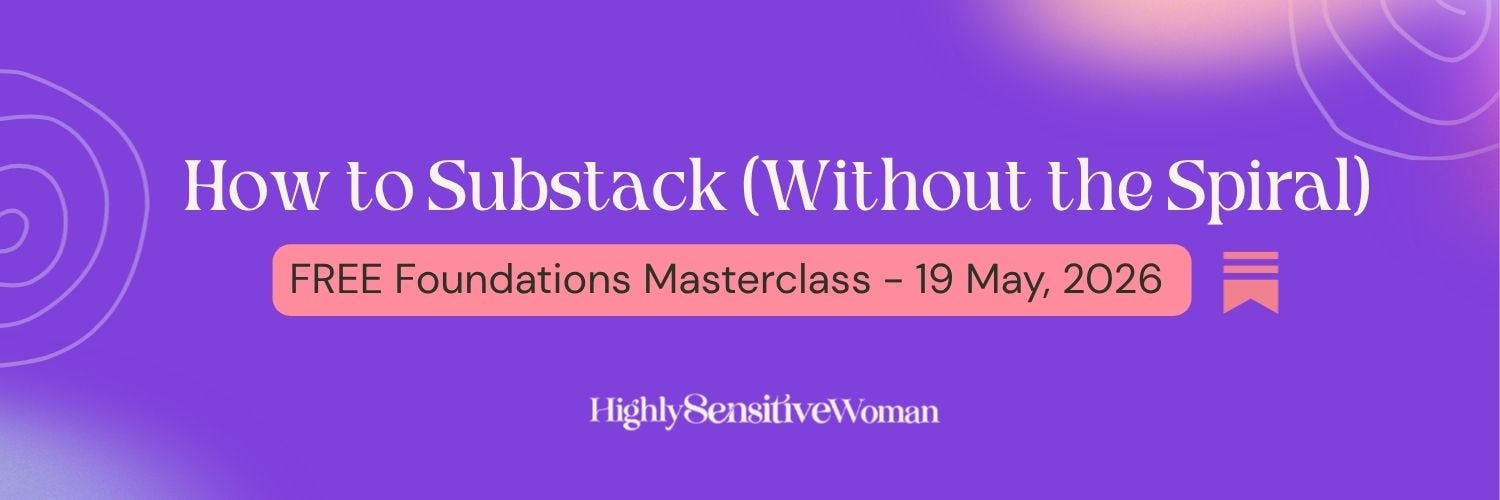
On Tuesday 19 May I’m hosting a free 90-minute masterclass — How to Substack Without the Spiral - specifically for sensitive, introverted, and neurodivergent women who want to build something real on Substack without torching their nervous systems in the process.
We’ll cover the foundations properly. Mindset, niche, messaging, the tech setup — all of it, at a pace that actually works for how you’re wired.
It just works better when you build it on solid ground.
Event Details
📅 Tuesday 19 May
⏰ 10am PT / 1pm ET / 6pm UK / 7pm SA
💻 Free
Bring your tea, your grandma, and your questions! I’ll see you there. 🌿
Andy x
I'm a few days new to Substack and really appreciate these unexpected tips - thank you! I signed up for your training on Tuesday and am trying to figure out how to make that time work. If I can't make it, will there be a replay?
I really enjoyed reading this Andy! You have so much wisdom around this that really integrates our sensitive souls as an essential part to consider, just as much as everything else. I especially LOVED and resonated with this part:
"Miss a week. Post twice in one day because you had feelings. Write something short when you have nothing left. The compounding effect of just continuing is more powerful than any posting schedule"
Although I haven't missed a week (which is a crazy achievement for me, something I've never been able to do is be consistent!) I have posted twice in a day when I was feeling passionate, and written short things because I was depleted.
What you said about the compounding effect of letting yourself be messy without stopping altogether is 100% absolutely true. I've felt it. It builds up a sense of grounding & rootedness within yourself that makes it feel like you can trust yourself and show up and perfection isn't necessary.
Love what you gently yet powerfully put into the world, as always 🩷